

What Is The Temperature At A Hot Water Baseboard Register
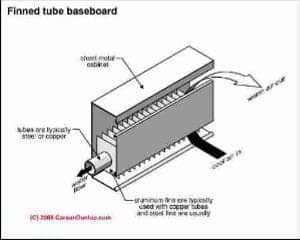 Guide to Baseboard Estrus
Heating Baseboard Inspect, Repair, Cleaning
- Mail service a QUESTION or COMMENT about baseboard heat and heating baseboard installations
InspectAPedia tolerates no conflicts of interest. We have no relationship with advertisers, products, or services discussed at this website.
Hot water baseboard heating systems:
This article describes the types of baseboard estrus used in buildings and nosotros explain the diagnosis and repair of heating baseboard troubles including no-heat or leaks or other problems. This article focuses on the installation, diagnosis & repair of hot water heating baseboards.
Nosotros discuss: How to inspect, diagnose, and repair bug with baseboard estrus. Inadequate linear anxiety of hot water baseboard: factors that determine how much baseboard is required. If your hot h2o baseboard is cold and the heating organization is "on" - here we diagnose the trouble.
Where leaks occur on hot h2o baseboards; Guide to unusual heating baseboards in buildings. How to raise up heating baseboard that lacks acceptable clearance from the finish floor surface.
This article serial answers most questions most all types of heating systems and gives important inspection, safe, and repair advice.
We too provide an ARTICLE Index for this topic, or you can endeavour the page top or bottom SEARCH BOX as a quick way to detect data you demand.
Baseboard Estrus: How to Identify and Diagnose Problems With Hot Water or Electric Heating Baseboards
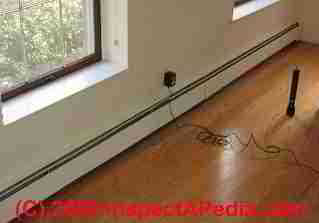 How Does Heating Baseboard Work?
Hot water heating baseboard is warmed by hot water circulating through either finned copper tubing or through cast iron baseboard sections.
Our photo of a heating baseboard at left and also Carson Dunlop Assembly' sketch (below left) and oshow a typical modernistic hot h2o heating baseboard organization installation.
Heating baseboard warms the room past a combination of radiation (the hot baseboard radiates estrus onto surfaces in the room) and convection (cool air enters at the baseboard lesser, is warmed, and exits at the baseboard top - see Carson Dunlop Associates'southward baseboard sketch at the top of this page).
[Click to enlarge any image]
How Does Cast Iron Heating Baseboard Work?
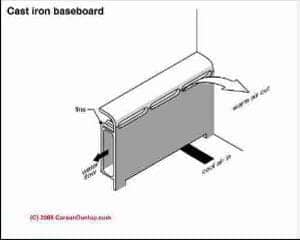
Carson Dunlop Associate'south sketch of cast iron heating baseboard shows the heating h2o and air period pathways of these heating units.
You can see by the larger water volume as well as the increased mass of the cast iron, that cast iron heating baseboards have more thermal mass than conventional finned-tube baseboard.
The increased thermal mass means more even heat distribution as the baseboards volition go on to radiate heat for some time even when hot water stops circulating through the system.
Sketch of a cast fe heating baseboard courtesy of Carson Dunlop Associates.
How Many Feet of Baseboard Heaters do We Need to Oestrus a Room?
The reply is ... it depends. Electric heating baseboard is figured at five to eight watts per foursquare pes of the room.
And for hot h2o oestrus, running a estrus loss model such every bit the excellent program provided by Slant Fin™ tin can give a good estimate of the number of linear anxiety of heating baseboard will be needed for a given room or building surface area. Just the following variables make an enormous deviation in the answer:
- The number and square feet of windows in the room and the window's R-value
- The room's insulation levels or R-values for its walls, floor, ceiling
- The room ceiling height
- The level of air leakage into or out of the room
- The heat output per linear pes of the model of heating baseboard called
- The catamenia-rate and temperature of hot water passing through the heating baseboard.
- Electric baseboard heat linear feet requirements are discussed
at Anxiety of BASEBOARD Oestrus NEEDED?
Guide to Diagnosing & Fixing Cold Heating Baseboards
 Cold Heating Baseboard Diagnostic Guide: how to diagnose a heating baseboard section, loop, zone, or room that is not receiving oestrus.
Make certain that your room thermostat is set to a temperature college than the temperature in the room - so that it is calling for rut.
Come across THERMOSTATS.)
Make sure that your heating boiler is working, that is that the heating boiler turns on and off usually.
A hot h2o heating boiler may not turn on immediately when you lot turn up the room thermostat: if the water temperature in the boiler is already in a higher place the aquastat'southward cutting-in temperature the circulators will ship hot water to the radiator and the boiler volition plow on later when its temperature is dropped past returning water from the cooler radiators in the building.
If your heat is provided by baseboards there volition non normally be individual shutoff valves at those devices, but if your system uses one circulator and provides multiple heating zones (and thermostats) there will exist zone control valves (usually about the boiler) that are opened or airtight by the room thermostat(s).
Air-Bound Baseboard Heating Zone Diagnosis
Once your thermostat is calling for heat and the heating boiler has been running for 10 minutes or more, merely feel the baseboard. Don't cut your fingers on the fins, and don't bend them if you lot tin can assist it.
If some sections of baseboard are not easy to access that's ok - you can simply feel the outset and the end of a section of baseboard to determine where the loop of heat pipage is hot and where forth the organization the baseboard piping first feels cold.
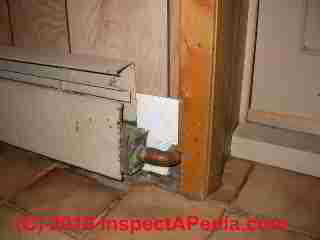
Our photo (left) shows an older finned copper tubing baseboard organization with the end-encompass removed - it's easy to only touch the copper pipe to feel its temperature - hot or cold, that's all we need to know.
If but some sections of an individual zone or loop of heating baseboard are non getting hot, feel along the piping entering and leaving each department of baseboard in each room to detect which sections are hot and which are cold - this is a kickoff diagnostic step in determining what'south incorrect.
If your rut is distributed entirely through ane zone (i thermostat, one loop of heating piping & baseboards) and if office of that loop is warm (usually just the beginning portion of the loop), and then there is a good hazard that your heating zone or loop is air-leap.
Also see heating baseboard air bleed valves discussed
at AIR BLEEDER VALVES for more details.
Since on many hot water heating systems a key air bleeding or air vent indicate is at the air scoop or air separator closer to the boiler,
see AIR SCOOPS SEPARATORS PURGERS.
Thermostat, Zone Valve, or Circulator Pump No-heat Diagnosis for Baseboard Heat
If your heating organization is divided into multiple zones of baseboards or a mix of baseboards and radiators: If the heating banality is running and some baseboard sections or rooms are hot but others are not, first check to see if your heating organisation uses multiple thermostats and multiple heating zones.
It may be that the thermostat controlling the "cold" rooms is not calling for heat or is non working.
See THERMOSTATS.
It could also exist that the circulator (encounter Circulator Pumps & Relays)
or zone valve (see ZONE VALVES, HEATING) controlling catamenia of hot water to that heating zone is non working.
If your heating baseboard is installed over a carpeted floor, be sure that the carpeting has not blocked the air inflow space under the bottom edge of the metal baseboard encompass. Blocking this air intake will drastically reduce the heat output from your heating baseboards, thus increasing your heating pecker.
Heating Baseboard Defects
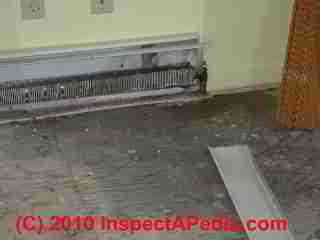
- Air-bound heating baseboards tin can preclude sections or unabridged loops of heating baseboards from getting hot. Details are
at AIRBOUND Oestrus SYSTEM REPAIRS
- Missing baseboard covers: the covers are required to clinch proper heating of room air by convection.
See RADIATOR BASEBOARD or CONVECTOR COVERS for tips on how to make or purchase replacement covers for hot h2o heating baseboards
- Missing baseboard cease caps: aforementioned every bit to a higher place (photo to a higher place correct)
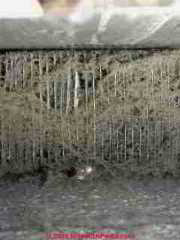
- Damaged or dust-clogged heating baseboard fins - reduces air-flow and thus heating output. It's like shooting fish in a barrel to fix this trouble by careful vacuuming of the heating baseboard fins using a crevice tool on your home vacuum cleaner.
Spotter out: be gentle or utilise a special brush attachment when vacuuming heating baseboard tubing and fins, or remove the baseboard covers if necessary.
If y'all are heavy-handed with the vacuum cleaner yous may curve and damage the fins covering the baseboard tubing, resulting in reduced heat output.
- Inadequate clearance between the baseboard bottom and the floor surface - blocks entry of cool air into the baseboard
- Leaky hot water baseboard connections, air bleeders, elbows.
Come across LEAKS at BASEBOARD, CONVECTOR, RADIATOR for details.
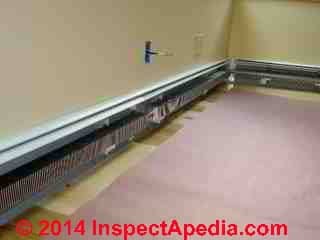
- Inadequate total linear feet of heating baseboard for the room size - inadequate heat output may leave the room besides dank on cold windy days.
Solutions to inadequate hot water heating baseboard installations include increasing the hot water catamenia rate through the baseboard past changing the circulator pump to a higher output unit, increasing the water temperature flowing through the baseboard, increasing the diameter of piping betwixt the heating boiler and the baseboard input and output ends, or irresolute the baseboard itself to a higher BTU output (per linear foot) model.
Our photo (left) shows heating baseboard beingness installed in a Poughkeepsie, NY home. The linear feet in this room was held to a minimum for room blueprint reasons, leading the builders (DF & Galow Homes) to select a higher-output baseboard design.
Lookout out: Unfortunately the installing Poughkeepsie plumber took some shortcuts and "saved money" by reducing the hot water piping feed and return piping from our pattern point of 3/4" diameter to his own preference for (easier and faster to install) 1/2" diameter piping.
Nosotros may demand to install a college chapters output circulator pump at this dwelling or perhaps we'll demand to install larger diameter supply and render piping. This installation remains nether evaluation.
- Unsafe electric heating baseboard installation details & clearances such as from curtains and electrical outlets or wires.
Run into Electric BASEBOARD HEAT Safety
Tepid or Cold Baseboards: How to Fix a Baseboard that Does Non Get Hot - Quick Communication
Make certain that your room thermostat is set to a temperature higher than the temperature in the room - and so that it is calling for estrus.
Make certain that your heating boiler is working, that is that the heating boiler turns on and off commonly.
A hot h2o heating banality may not plough on immediately when you turn up the room thermostat:
if the h2o temperature in the banality is already above the aquastat's cutting-in temperature the circulators will transport hot water to the radiator and the boiler will turn on later when its temperature is dropped past returning water from the cooler radiators in the edifice.
Complete details most diagnosing and fixing common cold radiators are found
at COLD HOT H2o BASEBOARD / RADIATOR
and
at COLD STEAM Estrus RADIATORS
Reader Question nigh a Cold Baseboard Heat Room on a Unmarried Zone - do I need to replace the aquastat?
2/thirteen/2014 Question - Honeywell Aquastat Control Replacement said:
Hi Just wondering if I'm about to get ripped off or should i tell this person non to practice the work. I have a 1800 sq foot 2 story house and the farthest bedroom on first floor (2 outside walls) away from the furnace in the basement (consistently freezing common cold outside) has been much colder than the rest of the firm (tenants keep heat at 75 and this room hovers effectually 64-68) It's a gas furnace
- He told me its a Peerless Banality and he is factory authorized dealer and the date on the boiler is May 2012. I take hot h2o radiator heat.
This new heating guy says the 1 year old Aquastat Control needs to exist replaced - that information technology is a part failure unrelated to the workmanship of the previous contractor who did the piece of work concluding year (i switched from Oil to Gas). That if he repalces the control that there is a seventy% take chances that this will solve the coldness trouble in the back sleeping room volition get warm.
If the whole residue of the house has been warm without any problem - is this actually the problem, wouldn't the rest of the house be cold as well? He wants to charge me $535 for the control 4 hours of labor at $65 an hour.
Now - its two days later, the room is still common cold and at present he's saying the baseboard heaters were installed wrong and need to be 'reworked' for $450.
That they are upside downwardly and this is why the room isn't warm (same original contractor who put in the new furnace put in these baseboards in last twelvemonth). I called the original contractor (wish i brought him over this time to begin with) only I'm working with a belongings manager now).
He says that what this guy is saying is non true - that they were put in correctly. It was me who decided to utilise a 4' shorter length on one of the walls and this could be the issue, but why and so did this new guy have to replace the control for $795. Do they actually cost $535 or is that mode high? Thank you for any aid or advice anyone can provide. -Paula
Reply:
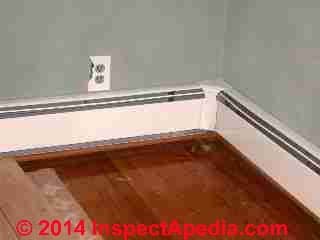
Really? I tin't make sense out of the explanation given by your service tech.
The aquastat turns the boiler on and off, and may control one circulator. I can't run across how information technology knows i room of the abode from another. The tech may be honest only a lousy communicator, but from just the information in your note, I don't get it.
In the article above y'all'll see more photos of normal baseboard installations. I've never seen heating baseboard installed upside down - I wouldn't even know how to do that.
At left I have inserted a photo of a normal hot water heating baseboard installation with the baseboards "correct side up" and with decent clearance betwixt the baseboard bottom and the floor surface. [We'll ignore for at present that broken electrical receptacle encompass hazard.]
[Click to enlarge any image]
Use the CONTACT link to send me some photos of your baseboards and we can comment farther.
Reader Question: contractor re-routed baseboard pipage, now some rooms don't heat-up
I but bought a house with baseboard rut, oil boiler. I take no feel with this blazon of arrangement.
Nosotros hired a contractor to remodel our kitchen and in the process he replaced some pipe in the baseboard area. Nosotros asked that a portion of the baseboard heaters be removed so that cabinets could be installed along that wall. Instead, he replaced the pipage and lowered the piping that runs along the wall with the new cabinets then that the pipe is touching the hardwood flooring beneath.
The cabinets are installed higher up the pipe- he cut out a notch for them. My first question is: is this safe?
My second question is: since he replaced lines, the thermostat in that surface area of the house e'er reads most 10 degrees lower than the setting. I have bank check the valves- they are all open. He says he bled the lines of a lot of air and yet nevertheless information technology is not right. Whatsoever ideas what he tin can practice to get the temperatures to fifty-fifty out? - Anon: 5 Mar 2015
Reply:
The contractor would take trouble completely "removing" a section of baseboard if that section was carrying hot water on to heat another portion of the habitation as southward/he would then have to observe some new (and more costly) route to get the heating h2o to that second area. That'southward why it's more common to practise what you described.
Equally long as the heating pipes accept adequate clearance to quietly handle their slight expansion and contraction as the pipage heats and cools you'll avert an annoying noise trouble.
The temperature of water in your baseboards is unlikely to exist much over virtually 180F and is not going to start a burn.
If you lot had some unlike safe concern in mind let me know.
Second if temperature in the house is never reaching the thermostat setting for that area and so the rut would run continuously - which would be plush. It's possible, especially if the baseboard pipage was cut and drained during the piece of work y'all describe and moreso if in that location are long horizontal runs, that the arrangement is airbound or partly air-leap.
The symptom would be that the boiler and circulator run and zone valves open up (if you've got zone valves) but baseboard doesn't go hot.
Encounter AIR-BOUND HEATING SYSTEMS [live link is at "Continue reading" just below]
A second possibility is that if you removed too much baseboard from the heating zone controlled by the thermostat that you cite, the trouble could be that the heat-loss charge per unit of the home in that area simply exceeds the heat supply rate from the remaining baseboard sections.
If that's the problem and so yous'd see that your baseboards are hot and the banality runs for long intervals or constantly merely the room just doesn't become warm. If that's the trouble you'd need to add more baseboard, ameliorate insulation, stop air leaks, or add auxiliary estrus.
Reader Q&A - as well meet the FAQs serial linked-to below
Thanks Peter.
Bottom line: if the thermostat is calling for heat and the circulator pump(due south) is (are) running, and/or the zone valve (if present) is open, and if the baseboard or radiator itself is not air-spring and so the most-common cause of cold baseboard or radiator will be that the organization hot water or heating piping is air-spring somehwere en-road or on occasion, the circulator impeller itself is not working or is chock-full.
At the Recommended Articles below you'll detect the detailed diagnosis and repair articles nosotros recommend.
Really your explanation how it works and should be done is non saying why is not working these radiators. These radiators was invented by stupid liar. Because no thing what these radiators was bedly designed. These fins not absorbin plenty oestrus and never can create heat standa up or old fashioned cast atomic number 26 radiators,plus these radiators can not be serviced,because there is no bleeders. Very stupid design and shpuld taken from market at all. Actully companies installed all sold these bad radiator should pay back for of radiator in north America or install better radiators.
We currently have hot h2o baseboard oestrus. Nosotros are installing new floor three/4 thick over existing flooring. Will this significantly degrade the efficiency of the estrus past reducing the airflow to the lesser of the baseboards?
I recently bought a house in new England with cast iron baseboard oestrus throughout. I like how well it works simply I'thousand concerned about the efficiency as in many rooms the floor has been redone then the lesser of the radiator basically touches the floor now, the original feet sit down in pockets in the new floor. Clearly this means much less air is getting under and around the radiator than should. They do heat the rooms fine, but my super low ceilings are really making the life easy there.
My question is would it be worth the hassle of somehow raising them up? I'd have to cut the plumbing and extend information technology an inch on each end some how to get to the normal installed pinnacle, simply if that saves me a few hundred in oil each winter information technology would be very worth it. Or am I just making a mountain out of a molehill
Hot water baseboard heating of 1973 has ii zone valves (i on main flooring and one in the finished basement). I have an on-going trouble that the tech/plumber doesn't acknowledge and is dismissive virtually. Both zone valves open/close properly. Both thermostats were recently replaced to see if that is the trouble. It wasn't. Problem: If main flooring thermostat is gear up at say 70F and basement 1 is set at 65F, all seems good. But if main floor thermostat is fix low, say 60F and the basement thermostat is set at 70F, the primary floor rads will however heat up fifty-fifty though the bodily room temp may be 75F due to sunlight or cooking. The chief floor rads (as well as the basement rads) seem to be affected past the basement thermostat. The opposite doesn't happen. ie, the upstairs thermostat set at a higher temp rightly doesn't cause the basement to call for heat. Any idea? (By the fashion, the plumber didn't even bother to feel the upstairs rads for heat; but said "Everything is working as it should". It isn't. )
Hi, My apt suite was built in 1963 with the old baseboard heater (boiler).
My question is:
Every winter does the Landlord (take to bleed the pipes) cause you lot constantly hear water running, splashing, etc & we quite often have no heat.
Landlord never comes into our suites to bleed it, he has information technology running all year.
Thank you Carolyn
Howdy - I need to notice someone to check my baseboards - bleed air, determine if circulator pump is working properly and is correct size. I zone of my 3-zone house outside Boston, Massachusetts has not been heating properly this winter. Who should I expect for to aid me with this? If y'all can refer me to a specific company, peachy. If not, a general description of who I should await for is fine. Thanks, Lee
John, at the end of this article in the More than Reading links see AIR-Jump HEATING SYSTEMS
Gale see THERMOSTAT WON'T TURN OFF institute in the Article Index Higher up
no water going to baseboards. is circulator pump
The baseboards never stop running and it turned down to 1 on the knob and it's nevertheless manner too hot in the apartment. Is the baseboards not suppose to stop running once it gets to a certain temperature?
Question: hot water heat freeze-ups
(june 19, 2014) anonymous said:
I have hot water baseboard system boiler in my crawlspace (.Basement) im thinking about replacing the boiler with a horizontal warm air furnace adams furnace. I proceed getting freeze ups and they are very difficult to repair.
The furnace adams make is supposed to be 95 percent efficient. Plus the fact there are no pipes to freeze is the warm air furnace the fashion to go? Thanks paul
Reply:
Paul,
You were commenting about hot water and hot air estrus on a steam estrus commodity - and so this may be a scrap disruptive to other readers, just in general, conversion to some other heating method is fine if you tin deport the expense; each heating blazon has its pros and cons so IMO in that location is not a single "right" answer.
Keep in mind that when you change from steam heat or hot water heat to forced warm air rut, your costs are much greater than just the heater itself equally you have to install a heat delivery system : air ducts and registers. That can be convenient in some building designs and quite costly in others.
Run into details at ANTIFREEZE for BOILERS
and at WINTERIZE A Edifice - dwelling house
Val information technology would exist odd for draining the building water supply piping to have an impact on the heating organisation pipage - UNLESS - there were a failed or missing check valve or backflow preventer between the boiler and its water supply piping. If that were the instance you'd think that if the building were tuckered entirely the boiler would have been completely emptied.
Endeavor the diagnosis and repair steps shown at More than Reading to a higher place in the article titled
AIRBOUND HEAT Organization REPAIRS
h2o company drained all h2o pipes in order to change meter. once h2o was restored I bleed radiator at highest betoken, I turned the heat dorsum on. raditors got hot but the hot water baseboard heaters did not get hot.
small baseboard heater is bath non getting hot
I really have 2 questions for yous.
I've been living in a garden apartment in a 1950s building in suburban Chicago since September. The edifice has baseboard rut. When I start turned on the rut in the late fall there didn't seem to exist any issues. In Dec, new building owners/landlord changed our thermostat and accept since been doing a lot of work on the building mechanicals, but non the private units. Since late Jan, whenever the heat turns on, I olfactory property a stiff solvent-similar aroma. Information technology slowly dissipates every bit the cycle runs, only returns over again when the system kicks back on and it is making me sick with headaches and nausea. This is simply in 2 (living room and bedchamber) of the iv rooms that have the baseboard heaters (both on the same outside wall of the edifice). The other 2 practice not produce this scent (kitchen is on a different external wall and bathroom is separate internal wall). The (new) landlord doesn't have any suggestions for me on what might be causing this or how to resolve it. Do you have any thoughts on what this might be?
Question 2: The last 2 days, I have also been noticing a lot of water noise from all of the units and (my bathroom wall is shared with the mechanical room) banality. Last night information technology actually sounding like a swimming party in the boiler and like I take h2o features installed for the sound (or I live in an aquarium store). My temperature does not seem to exist impacted. Do I need to worry well-nigh this? Should I call the landlord to report a problem?
Thank y'all for any direction y'all can provide!
Usually yep
If I close the vent in another room, will it exist warmer further down to other rooms that are not as warm?
Anon stop past your local heating supplier: there are a number of manufacturers of replacement baesboard covers. Go on in mind that just the hung-on front end cover and possibly the moving louver can be replaced without completely removing all of the baseboards from the walls.
what to replace onetime slant fin covers with a tertiary party ameliorate looking cover, is this possible? Do you accept a line a such company.
Wendy
Anon
Indeed this is a surprise: when a heating system is air-spring we await the warm pipes and baseboards to exist on the incoming side of the air-spring location - that is, hot water flows from the banality as far as it tin can get before information technology is blocked by air (or more rarely past something else). But your heating organisation baseboard pipage is an unknown. If the baseboards were piped in parallel rather than in serial, the trouble could be air within individual baseboard sections. If there are no air bleeders on those baseboards I'd ask the heating service tech to add them as part of a project to properly purge the system from air.
...
Continue reading at AIR-BOUND HEATING SYSTEMS or select a topic from the closely-related articles beneath, or see the complete ARTICLE INDEX.
Or run into these
Recommended Articles
- AIR BLEEDER VALVES for how to discover and operate those cute petty controls on baseboards (or radiators)
- AIR-Jump HEATING SYSTEMS - no heat because air is trapped in piping
- BASEBOARD Oestrus - dwelling
- AIR-BOUND HEATING SYSTEMS
- COLD HOT H2o BASEBOARD / RADIATOR
- LEAKS at BASEBOARD, CONVECTOR, RADIATOR
- DIAGNOSE & Ready HEATING PROBLEMS-BOILER if the banality is just not working like information technology should
- NO HEAT - Banality
Suggested citation for this web folio
BASEBOARD Estrus at InspectApedia.com - online encyclopedia of building & environmental inspection, testing, diagnosis, repair, & problem prevention advice.
Or run into this
INDEX to RELATED Articles: ARTICLE Index to HEATING BOILERS
Or use the SEARCH BOX plant beneath to Ask a Question or Search InspectApedia
...
Ask a Question or Search InspectApedia
Try the search box just below, or if you prefer, postal service a question or comment in the Comments box beneath and we will respond promptly.
Search the InspectApedia website
Note: appearance of your Annotate below may be delayed: if your comment contains an image, web link, or text that looks to the software equally if it might exist a web link, your posting will appear after it has been canonical by a moderator. Apologies for the filibuster. Our Comment Box is provided by Countable Spider web Productions countable.ca
Technical Reviewers & References
Click to Prove or Hide Citations & References
Publisher InspectApedia.com - Daniel Friedman

What Is The Temperature At A Hot Water Baseboard Register,
Source: https://inspectapedia.com/heat/Baseboard_Heat.php
Posted by: corralthiphrisity.blogspot.com
0 Response to "What Is The Temperature At A Hot Water Baseboard Register"
Post a Comment